We took a drive through the southern French Alps, on the other side of where we live yesterday. Our destination was the village Bayasse. Col de La Cayolle is the name of the pass, which takes you into real Alps territory, whereas we live in part of the Alps considered Alpine and Mediterranean climate still. It was as if we had shrunken into tiny versions of ourselves and transported into a painting. The Mélèze, European Larch trees, dabbed the landscape with their yellow pine needles. Their lightly textured presence contrasted beautifully with the deep evergreen pines woven into the landscape. Small streams slithered through hillsides. Nature is such a talented artist; she places things in such perfect places and proportions. My eyes were acute, delighted, absorbing all they could.
An hour in our drive, I needed to pee, so Jorris pulled over. Stepping out of the car I thought it would be freezing, but actually, it was sunny with just a touch of chill. And the air was astoundingly quiet and clean, the kind of quiet and clean you can only find at 780m (5,800ft) above sea level.
We were almost there Jorris said and I couldn’t wait any longer. A few more narrow turns and we approached the house. I was so excited, like Charlie winning the Golden Ticket to visit the Chocolate Factory.
 |
| Their home and Bed & Breakfast upstairs with boulangerie (bakery) below. |
 |
| Wood of pine and Mélèze for the bakery wood oven. |
 |
| Stephanie Les Cordiers and Cedric Monasse of Pain de Bayasse. |
Cedric greeted us with his usual friendly smile and the customary French two bises on both cheeks. He is the Master Baker of our phenomenal daily bread. It wasn’t our first time there; however, it would be our first time witnessing him and Stephanie bake bread. We sell our artisanal products at the same markets in Guillaumes together, so we see each other once a month. It had always been in the back of my heart to visit them and watch them work one day, but I was always too shy to ask. As my Mom has said though, “a closed mouth don’t get fed”. If I wanted to taste fresh bread, I would have to open my mouth to ask, and so I did. Cedric said yes and after some planning, we found time to come.
If only my words could bring to life the adoring, cozy smells of wood-fire and freshly baked pain au levain naturel from Cedric and Stephanie’s boulangerie (bakery). I’ll try though. After yesterday’s, what we found out later, exclusive bakery visit, I’m certain that once in your life, you should go visit a baker and see the magic of bread being made. Go ahead, add it on your bucket list now; I’ll wait.
 |
| Loaves of bread waiting to go into the wood oven. |
 |
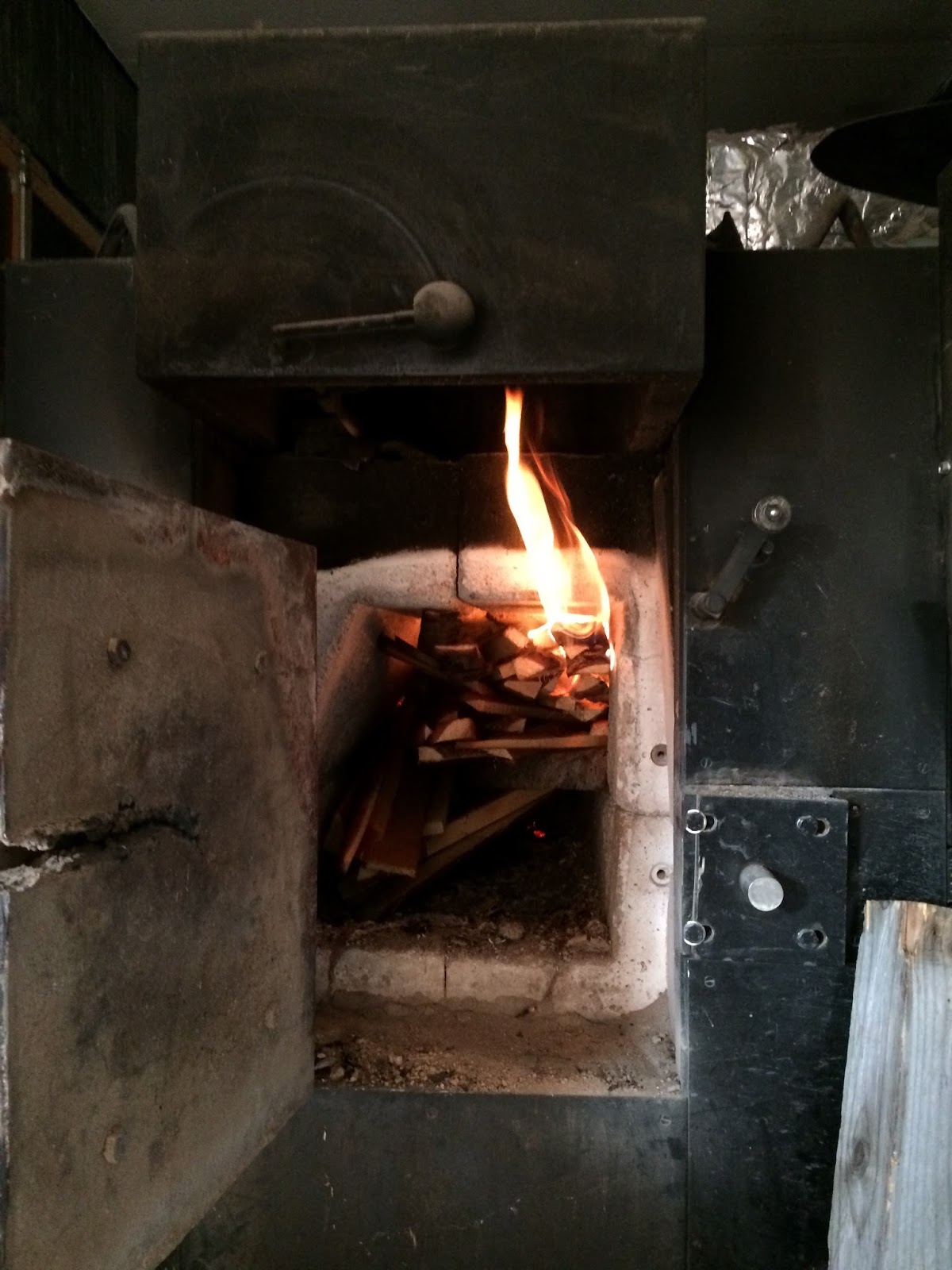
| Wood oven with switch above directing flames to bread. |
The dough loaves of bread were sitting patiently on these shelves with wheels during their stage of final rise, also known in the baking world as "proofing". They were on this canvas material, folded like an accordion, each loaf of soon-to-be-bread, tucked between the folds.
The warmth of the bakery was just so perfect. There’s nothing more
hygge than a warm wood fire, except perhaps the smell of baking bread.
Cedric and Stephanie had been up since 6 a.m. staring the wood oven, since it needs time to cool down before the bread can be baked. With the oven started, they have time to shape their dough and let it rise.
Flour, water and salt are mixed together in this giant mixer called a petrina. Depending on the sizes of the bread, one petrina can mix between 60-90 loaves of bread. After mixing, the dough sits in here where "bulk fermentation" will happen. This is a crucial step during bread baking as this is when the wild yeast and bacteria do most of their work, breaking down the complex carbohydrate structures of the flour, which in turn reveals more flavors for us. Wild yeasts, unicellular fungi, and bacteria from the lactobacillus family eat up the sugars of the flour, releasing ethanol (alcohol) which increases flavor, as well as carbon dioxide, which helps bread develop better structure as gluten traps these air bubbles, creating a network. Basically, fermentation is the process of the yeasts and bacteria eating up the sugars, breathing, farting, pooping, and voilà, subtle flavors and delicious textures for us! Of course when the bread is baked, these friends die away and the alcohol and carbon dioxide evaporate; however, their flavors linger. After bulk fermentation, Stephanie divides up the dough, weighing out each loaf, shaping, and placing them snug on the canvas accordion. There they wait during a final rise before going into the oven.
 |
| The petrina, can mix between 60-90 loaves of bread. |
 |
| Stephanie weighs out dough for each loaf of bread. |
 |
| Here Stephanie shapes the dough. |
Between waiting for the oven to cool down and taking pictures, Jorris and I found time to ask questions like: how does your bread rise? He uses the traditional method of ancient days. In French it’s called levain naturel, natural leavening. Basically, it is a live culture produced in fermented flour and water. Natural bacteria in the air and/or flour such as lactobacili and wild yeasts begin to ferment over a few days. It’s what is commonly known as the sourdough starter. Add some of this starter to more flour and water, bake, and you get bread. This is how bread was discovered by accident. Some flour fell into water, sat exposed to air for several days and voila, a natural leavening agent, which makes bread rise. It’s been recorded as early as 2000 B.C. that the ancient Egyptians made bread this way. No packets of any chemical agents or factory-made yeast.
At the beginning of the 20th century chemical oxidants were discovered to cut fermentation times from 18 to 3 or 4 hours. With these chemical additives, a batch of bread can be made in several hours. These breads are called “quick breads”. Chemical additives are used in many modern day retail bakeries which speed up both mixing time and reduce fermenting time.
Many good things in life as we know; however, take much time. Traditional bread baking is really an art, requiring patience and time. Time for the starter culture to ferment, time to mix, time for the bread to rise, time for the oven to be at the right temperature etc. It is through the time consuming process known as fermentation, however, that foods such a: sauerkraut, wine, and bread can taste so good. Of course there is a range of flavors and textures, which can be discovered in sourdough breads, which makes sourdough interesting and tasty, not to mention better for our digestive systems since these natural bacteria and wild yeast are eating, reproducing and processing the wheat so it’s more digestible, nutritious and easily absorbable by our bodies. Taste can be contributed to the type and amount of bacteria doing the fermenting (alcohol fermentation) as well. For example, too much lactobacilli in your starter culture and you get a lot of sourness, so you have to taste test over and over how much of your starter to add to your batch of dough until you get the preferred taste.
 |
| Cedric, sliding off just-baked loaves from his peel to the table. |
 |
| Sesame bread just baked and out of the oven! |
 |
| Here the breads cool before delivery tomorrow. |
Cedric and Stephanie have got the taste and method down. Their bread is not sour and has perfect texture and color. Watching them in their rhythm of work was mesmerizing. Cedric would slide 60-80 loaves in the oven onto the spinning disk; meanwhile, while in the other room, Stephanie would be weighing out the dough and/or shaping the dough into loaves for the next round. A quick 20 minutes and turn of each loaf later and the loaves of white dough were completely transformed into brown loafs of deliciousness. Cedric took them out with the same precision and speed. Sliding loaves from his peel onto their place randomly on the wooden table. Steam rose from the freshly baked breads as Cedric smiled at our amusement and enthusiasm. The aromas of these natural beauties made my mouth water.
There are many factors to consider when baking bread: temperature, both inside the oven and outside, humidity, even the moon!
Cedric explained with a chuckle that, "When it’s a full moon, bread does not want to rise!"
But, according to Cedric, the most important thing is feeling. The dough and heat of the oven for example are important elements to really feel. I watched this in action as he hovered his hand in the oven door! He said if he can’t leave it in there for 5 seconds, it’s still too hot.
He and Stephanie get their flour from Valensole where the Lavender grows and
Moulin Pichard, a well-known traditional mill in
les Alps de Haute-Provence established before 1789, even before the French revolution.
Their sources of flour are both local and
bio, the word for organic in French. Why not certify formally as organic? I wondered. Why be certified for doing the right thing, making bread the right way? The ones who need certification are those who alter traditional bread baking by putting in additives and chemical risers, according to Cedric vehemently.
Each year they make about 12,000 loafs of artisanal breads including specialty breads of: olive, raisins; fig and hazelnut, sesame; apricot and almonds!! Not to mention some delicious pastas. Since their start 7 years ago, they humbly estimated that they’ve made probably around 100,000 loaves of bread. Incredible, as he was an apprentice for just a year before he started baking on his own. That is a lot of bread, which literally feeds villages. Our village is one of them so fortunate for their delivery of bread each week to the Co-op store. They even make delicious and beautiful pastas!
 |
| Shell pastas, one of their many varieties. |
 |
| Fusilli and Radiatori pastas; 100% wheat and organic. |
For me, to know the source of one’s food, what nourishes our bodies, minds and souls day to day, as intimately as we have observed Cedric and Stephanie baking bread is truly unique. Unless one lives a countryside life, it’s not often easy to say we know our bakers, cheesemakers, beekeepers, etc. Most city dwellers whom frequent the supermarkets are veiled from the artisanal beauty and quality of real food. It’s a pity! C’est un dommage! We say in French. Having experienced both sides of the coin now, I know from my own experience.
There is a deeper appreciation for the food you eat when you know where it comes from, or even better, when you produce it yourself. Knowing where our food comes, we come to question, discover, and hopefully, better understand our food web. We live an inter-dependent world. We depend on the Sun, which grows our food that the farmer cultivates and harvests, which if we buy from far away, that food travels thousands of miles releasing fossil fuels into the atmosphere, which we breathe. One question leads to another. For example, wondering where our bread comes made me wonder where the flour comes from and then that lead me to discover the traditional mill. Knowing the flour is organic from organic grains is incredibly reassuring with all of the GMOs (genetically modified organism) out there, pure food seems more difficult to come by.
 |
| Stephanie Les Cordiers of Pain de Bayasse |
 |
| Cedric Monasse of Pain de Bayasse |
You’re probably wondering, boy that’s a lot of work to know about your basic bread, Tiffanie; I don’t have time to question life. But actually for me, it’s a necessity; it’s a responsibility. How we spend our money and whom we support in agriculture or in any industry for that matter, makes a difference. Knowing what we put into our bodies and how it affects our health and well-being is part of our responsibility of taking care of ourselves and our families. Knowing that our food has been produced cleanly without chemicals and in harmony with the earth is part of our responsibility as citizens of this inter-connected world. It’s worth the time and effort to wonder and ask questions.
Supporting traditional ways of producing food like Cedric and Stephanie’s artisanal bread is not only about preserving taste, but also culture. If people began only shopping at the supermarket and forgetting about artisanal bakers like Cedric and Stephanie, we would be lost forever in a sea of florescent lights and ails after ails of plastic-wrapped fake bread. Let’s not let that happen.
So, what is a Bread Master’s favorite way of eating bread? Can you guess? Cedric tells us over lunch of some pumpkin and butternut squash soup, "Old bread, pan-fried with butter and put into soup". We’ll have to try that!
 |
| Beautiful views at the Bed and Breakfast of Pain de Bayasse. |
Planning a visit to the French Alps or to
Mercantour National Park? Visit Cedric and Stephanie for some fresh bread at their quaint Bed and Breakfast.
*photos by Tiffanie Ma